


Jordan Crandall
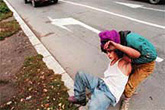 ..found photography ..found photographyIn the future, people will look for art in unanticipated experiences, which then have aesthetic dimensions. Accidents perhaps. Simple occurrences that stick in the mind, and which upon reflection become extraordinarily complex. The future of art will be decided in the battles for this kind of reflective space. Here is an example. Several months ago, I was strolling along the facade of the Guggenheim Museum in Soho, in the company of a curator. Suddenly, in front of the entrance door, she stumbled and plunged face forward, in a long, elegant arc, landing facedown on the pavement, arms and legs sticking straight out to the sides, books and papers flung everywhere, coins rolling loose onto Broadway. It was a fall that was completely unanticipated, and totally unprepared-for, from beginning to end. It was the best kind of fall: surrendered completely to the experience, with all modes of protection inactivated, still and dormant. I can only remember this scene as a slow-motion playback -- a graceful, beautiful plunge the likes of which I have not seen since, and which even now leaves me breathless. When you fall, you want to pretend that nothing happened. You get up quickly, gather your belongings, dust yourself off, and walk away. You feel the weight of eyes fixed upon you and you want to quickly shake them off. Not only are you made painfully aware of the weight of the earth, the weight of gravity, but also the weight of collective vision cast upon you when you are not prepared to assume it. Weight and vision intertwine. You are not a conduit but a lump, a stopper, a dead weight halting the flow. You are not ready for your scene, you have been dumped upon the stage, and you have no lines at hand. And the fallen body is actually physically heavier, a bundle of uncoordinated segments, no longer enmeshed in the vectors of force, resistance, and proprioception that animate it and give it lightness. Vectors that give it bearing. It has literally fallen out of the circuit in all senses, cast out from the nets. Spectators, held in thrall at the scene of the collapse, quickly become embarrassed to stay and stare any longer. Already frozen still and held spellbound by the experience, they are compelled to move on. The experience lingers, but never in its full glory: that for one instant, motion came to a halt, passersby were stopped in mid-stride, and all eyes were focused on a single scene in synchronization. Something extraordinary erupted through the scrim. Another system of vectors in which to see weight, existence, movement. What more could an art work offer? How beautiful is such a moment of reversal, when even falling becomes a kind of ascension. Jordan Crandall New York http://jordancrandall.com |
