|
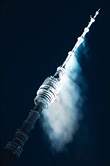
TV Tower, Moscow, 2000. Artist: Serhiy Ilyin.
"The straight forward, short sighted view of the future is
not what art is about. Nor should art project utopia on to a future
which is indelibly engraved onto us by economic and technological
laws and is already present in our daily experience. Art has to
reflect its own process, think about itself and define itself in
its own tradition. Art is a discontinuous work on self-consciousness,
suspending chronological sequence and examining the past and the
future through a cross-eyed perspective."
(Synopsis to Gianfranco Maraniello's contribution in Anthology of
Art #01/26) **
Marta Kuzma – Response
Art as the infinite capacity of subjectivity requires for it to
be completed in some way and not simply to exist autonomously. Art
must be completed by a philosophical criticism that enables its
truth to be displayed, substantiates its cultural authority and
provides the means for the object to be infinite and timeless. The
institution traditionally investing this art with its authority
faces its own crisis in its ability to convey the particular essence
of experience which validates the infinite nature of the work. By
regarding art as autonomous and autogamous is to effectively render
its end. In approaching the notion of futures, perhaps it is sufficient
to consider new interpretations critical in communicating why an
object, and I refer to the material of this object as being infinite,
is art rather than mere cultural representation. In exhausting the
discourse of the medium (painting, sculpture, video) and discussions
around the Duchampian tradition that purport there is effectively
nothing that separates art from any other object, a language must
evolve around other types of cultural representation without resorting
to traditional discussions.
If the art discourse has collapsed, perhaps it is time to once again
reconsider the artist, not as genius, but as a producer of an entire
cultural infrastructure investing the capacity to convey experience
that is no longer possible within the institution. Already enabled
by the fashion and celebrity industry, the artist centers production
not as supplemental to or in support for advertising but by virtue
of an unmediated entanglement. The artist has the possibility to
effectively substitute the entire industry without having commercial
product placement as a goal. This introduces the artist as conglomerate,
or monopoly, in situating the culture industry as a replacement
to ideology which has, for all practical reasons, already ended.
In this way, reconsideration as to the validity in the concept of
pleasure is introduced after its lengthy disregard within past art
and literary theory.
The format of the group or collective provides for a more logical
space for art production without the traditional aspirations in
producing a manifestation of utopian ideas. Instead, the artist(s)
as cultural producer assumes the role of architect, urban planner,
or surveyor who drafts a framework and the possibilities therein
that lend to flexibility in re-entering territories, disciplines,
cultures, industries, and even political parties. This guarantees
the mobility of each of the group's components, be that a physical
subject or an idea, or object, responding to the peripatetic and
malleable demands of the present world. Art will depart from being
collected and exhibited within an intimate or even grandiose manner
in the form of galleries and homes, but instead, may initiate the
remapping of territories around it, determining inevitably the shape
of homes, domiciles, and even cities based on the premise of endlessness.
In such a schematic, existing art institutions, specifically museums
rather than more generic cultural institutions, evolve anthropologically
exhibiting masterpieces of contemporary art from the 20th and early
21st century within temple-like structures that serve as monuments
onto themselves. The curators will remain as whirling dervishes
who serve as emissaries exhibiting wares and examples of production
from other centres of the world.
I agree in the author's premise that constructing or imagining a
future or future art remains futile. However, the reasons lie not
in the lack of importance in its imagining but our inability to
fathom such a future without the very concept of future having been
fetishized. In fact, our past notions of future had been constructed
around the entire machinery of imaginings generated by the Cold
War, the fear of nuclear catastrophe, and aspirations of the Space
industry. Consequently, our fears, tribulations, aspirations were
clearly constructed in fantasy space and in the media. As that polemic
advanced beyond East/West, contentious territories are no longer
as geographically visible, and the notion of struggle develops as
a rhizome whereby the notion of invasive agent is amorphous. The
daily reality of abnormal glips, permutations, aberrations, and
the appearance of "sleeping cells", becomes a regular
nuisance impeding the sedimentation and bracketing of ritual, leading
to a breakdown in the sanctity of tradition. For this reason, the
very notion of future as a system of vectors applauding progress
and utopia is a void characterized by the cacophony of simultaneous
frequencies and mixed transmission systems.
Marta Kuzma
London
...........................
** Editor's note: The English synopsis to Maraniello's Italian
contribution to the Anthology of Art #01/26 which is cited here
was written by the editors. Under pressure the author was not consulted.
|


